Partitioning and Invariant 4-Volumes
 Transmission Control -
Originally published on Medium.
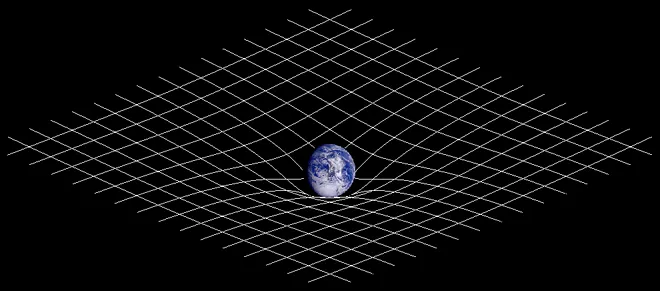
It’s reasonably well known in physics that one of the consequences of the invariant time interval is that there is an also invariant proper 4-volume. The spatial 3-volume contracts exactly inversely to the dilation of the proper time interval, leaving the space-time 4-volume unchanged.
At first blush, one might interpret this as a simple constraint on processing power. The more energy in a volume, the slower it performs relative to adjacent volumes. This, however, isn’t quite the whole story, because it also appears that it steals processing power from adjacent volumes. This is less obvious in special relativity than in general relativitiy as, in the former, one doesn’t usually contemplate the effect spreading outward with the inverse square of the distance.
With such a partitioning strategy, it becomes nearly, if not completely, impossible for any given volume to stall entirely and even harder for the whole system to stall but it doesn’t fully eliminate lag between partitions. This would appear to be a compromise somewhere between fixed partitions and an ideal dynamic partitioning strategy that redistributes load to wholly avoid lag hotspots. A less than ideal strategy would certainly be required if the total energy (computational complexity) in the system were to increase faster than the available processing power. This might well be the case in an expanding dark-energy dominated universe if the processing power were fixed.
Would such a solution make sense for partitioning a simulation? In the context of gaming where an avatar is controlled by an end user, I expect this would not be a welcome solution. Users expect you to provide as much processing power as is necessary to eliminate server lag even if it requires phased sharding that separates them into separate pocket universes from other users. However, in the context of other forms of simulation such as for evolving cooperative and adversarial AIs, this could well make sense. Clearly it is also necessary for us to accurately simulate parts of the universe we find ourselves living in. So much for the idea of a ghost in the machine — it likely couldn’t cope with the lag.